Showing posts with label WebSite. Show all posts

Sunday, 3 April 2016

, ,

What is the difference between domains vs hosting vs website?


When you have a site visitor, they use your domain name to view your website. As simple as it seems, there is a process that occurs from the time that the site visitor types in your domain and presses enter.

When a site visitor enters your domain name into a browser, the domain is then translated into your server IP address,  then the server sends that user your site files, which their browser represents to them as a typical web-page.You can see that, without each of these 3 elements, you won't really have a web-site.

The three basic parts that make up any current day website are:

Domain Names See Below
Web-Hosting Servers See Below
Site Files See Below

Domain Names

Computers communicate by using numbers, called IP addresses, to contact each other, much like you use a phone number to dial a specific person's phone. Domain names on the internet are much like entries in a phone book. The phone book tells people looking for a business what the entries are just as a domain tells people (i.e. their computers) that a domain is hosted on the server.

Without a domain, you would have to tell your customers that your site is located at a temporary url such as 123.456.789.123/~mysite instead of using a domain name such as mysite.com, making your site appear unprofessional and impractical.

Web-Hosting Servers

The web-hosting or server is much like the space that you rent out to have your business in. It's merely the space itself. It does not include furnishings like shelves for your products, just as the web-hosting account doesn't include a site for you to sell your products.

Luckily, in the web-hosting world, it's very easy to furnish the space provided by your host, because you can install many framework applications through the QuickInstall icon within your cPanel.

Without the hosting services, you won't have a place for your files to reside, so your domain would then become like a disconnected phone number in the phone directory, and your site files would have nowhere to stay.

Site Files

The site files are what your visitors and potential customers actually see when going to site such as your products and services. The site files are the same as any other file you normally use, like a .jpg photograph, or .mp3 music file. Though, website files are also .php files or .html files, which are PHP scripts or html pages respectively.

The web-hosting server knows how to read these files, which explain how the webpage looks or instruct the server to do a series of computations. These computations are things like figuring out what blog article it's supposed to send back to the viewer, or what forum post it's supposed to send back.
, , ,

12 Small CSS Frameworks To Use In Your Web Designs

You probably don’t need most of the features that come with large UI frameworks such as Bootstrap, especially when you’re working on small, straightforward projects that you just want to get up and running as soon as possible. Fortunately, there are smaller, simpler CSS frameworks out there that you can use instead.
Using a small CSS framework typically translates to a gentler learning curve for developers, non-dependency on JavaScript for functionality, and faster load timesfor your users.
I’ve created an excellent list of small/minimalist CSS frameworks for you to explore. Most of them are under 5 KB (when minified and gzipped) and contain the essential ingredients for building responsive web designs.

min

min
min, the smallest CSS framework on this list, has a responsive 12-column grid system, button styles, table styles, Android-compatible icons, and more. min even supports ancient browsers like Internet Explorer 5.5.

Milligram

Milligram
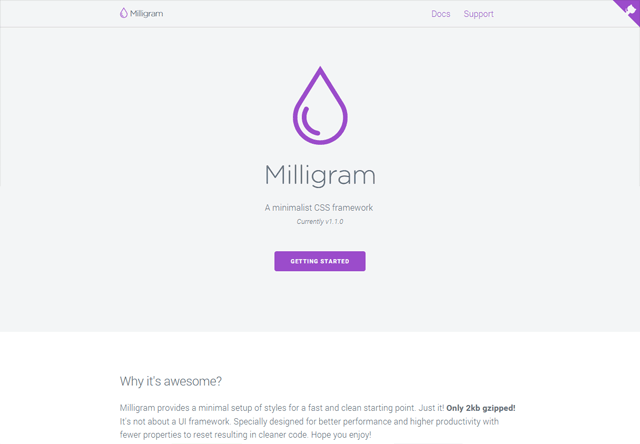
Milligram is for modern UIs — its grid system uses FlexBox, sizes and lengths use the rem unit, and it’s Mobile First. Being on the cutting edge comes at a cost: Milligram only officially supports the newest versions of Chrome, Firefox, IE, Safari, and Opera.

Blaze CSS

Blaze CSS
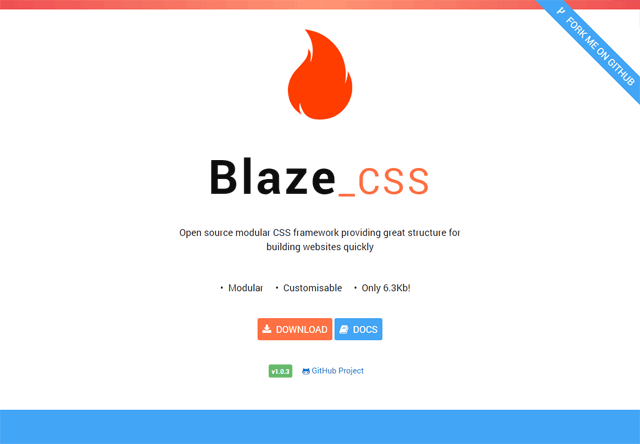
Out of the box, Blaze CSS is already lightweight, but you can reduce its file size even more due to its modular architecture which allows you to include only the parts you intend to use in your project. (Read the instructions for creating a custom Blaze CSS build for more info.)

Kube

Kube
Kube packs a punch for a CSS framework that weighs less than 6 KB. It has a responsive grid system, a robust set of classes for styling your web forms, multiple table classes, notification classes for displaying important messages to your users, and more.

Pure

Pure
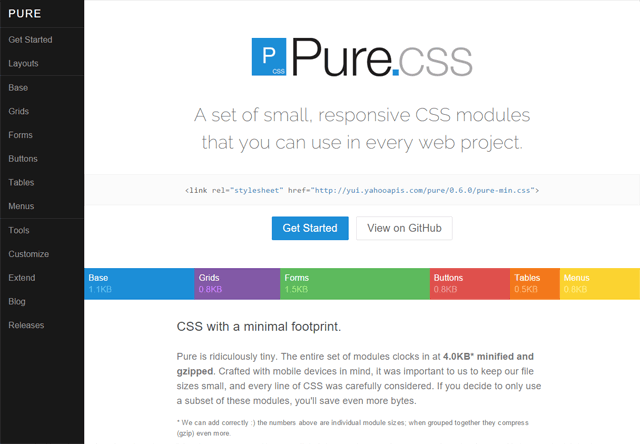
Pure, an open source project led by Yahoo! developers, is a suite of CSS modules that will help you quickly build responsive web designs. Pure has basic styles for all HTML elements (developed on top of Normalize.css), and modules for grid layouts, web forms, buttons, tables, and navigation menus.

Furtive

Furtive
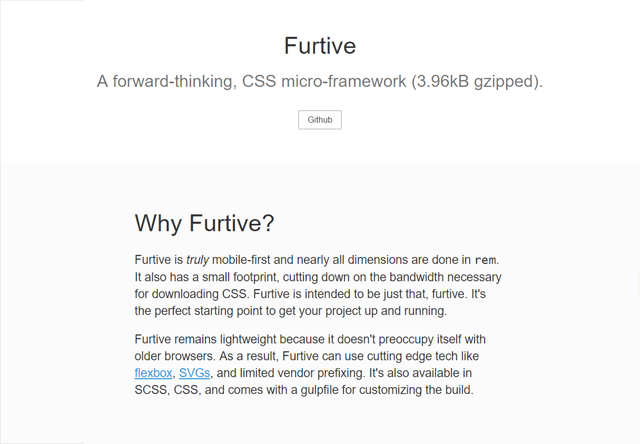
Calling itself a "CSS micro-framework", Furtive is geared towards modern web designs. Like Milligram, Furtive is Mobile First, has a responsive grid based on FlexBox, and uses the rem unit for lengths and sizes. It has the basics covered: buttons, forms, and even default color classes.

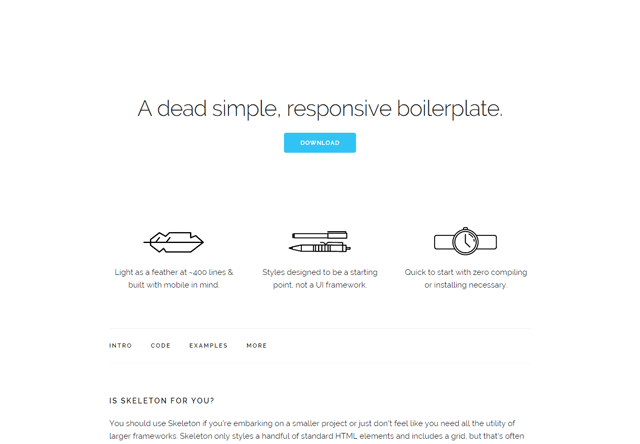
Skeleton

Skeleton
Though it hasn’t been updated in over a year, Skeleton is still a top-notch starting point/boilerplate for rapidly building modern, responsive web designs. It comes with an intuitive grid system and base styles for your HTML elements.

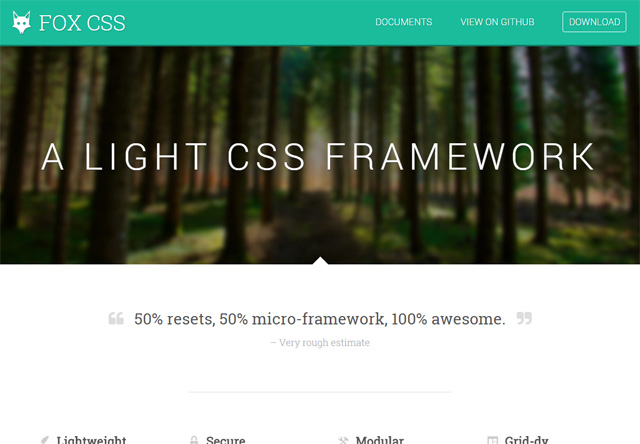
FOX CSS

FOX CSS
FOX CSS is a lightweight, modular CSS framework. It uses the Mobile First design approach, supports browsers as old as IE 9, and has a non-aggressive CSS reset(inspired by KNACSS).

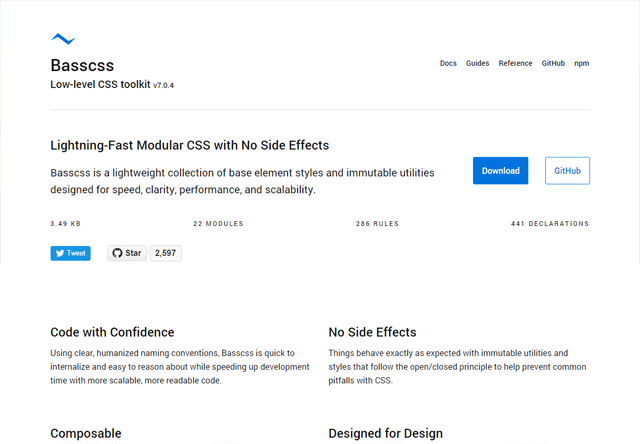
Basscss

Basscss
Basscss is made up of 22 CSS modules consisting of a CSS reset, a grid system, color classes, utility classes to help you build your responsive designs, and much more. Basscss is surprisingly feature-rich for something that weighs less than 4 KB.

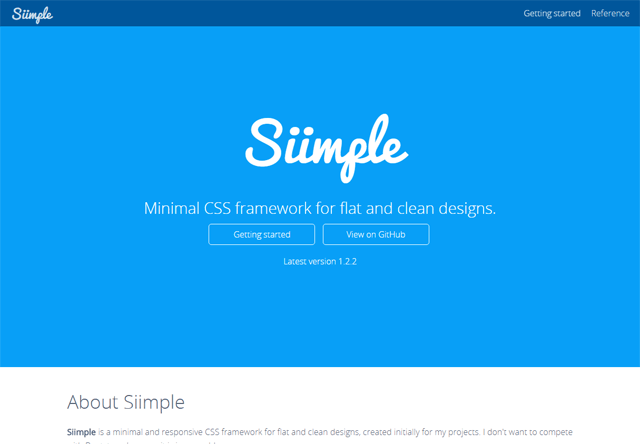
Siimple

Siimple
Siimple is a minimalist CSS framework for building responsive, clean web designs. It’s similar to Skeleton: It has an intuitive 12-column grid system and base styles for typography, tables, buttons, forms, and more.

Lotus

Lotus
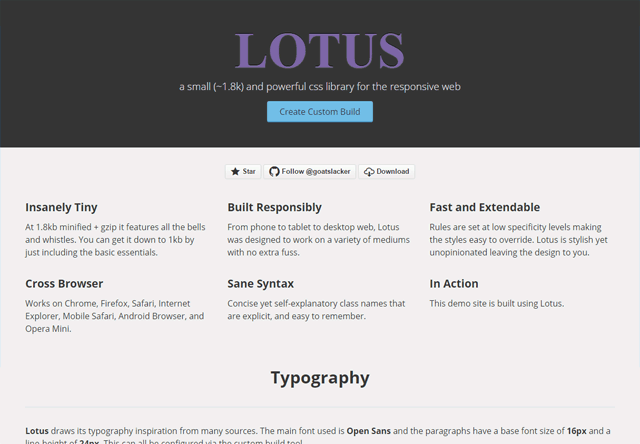
Lotus is one of the smallest CSS frameworks out there. It’s got the essentials covered: a responsive grid system, typography, buttons, and web forms.

Picnic CSS

Picnic CSS
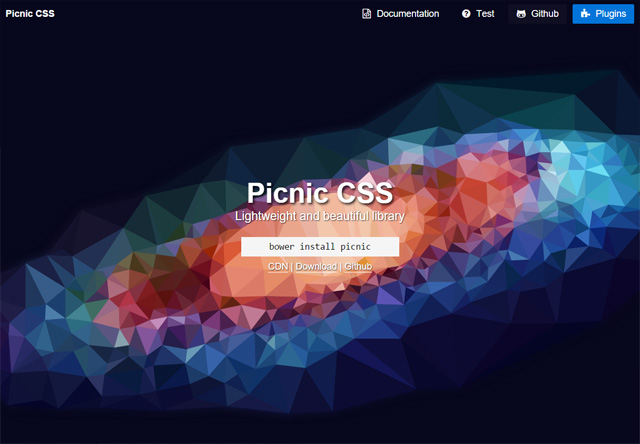
Picnic CSS is a lightweight UI framework written in Sass, making it easier for you to edit and customize variables such as colors and lengths. It also has some impressive, purely-CSS UI components such as a modal window and a content slider.

Summary Table

The following table contains useful details about the CSS frameworks featured in this list.
NameSize*DocsLicenseGitHub RepoPopularity **
min1.02 KBDocsMITRepo685
Milligram4.05 KBDocsMITRepo3,000
BlazeCSS5.71 KBDocsMITRepo7
Kube5.94 KBDocsMITRepo (outdated)538
Pure4.0 KBDocsBSDRepo13,373
Furtive2.37 KBDocsMITRepo369
Skeleton1.57 KBDocsMITRepo10,884
FOX CSS2.46 KBDocsUnknownRepo87
Basscss3.49 KBDocsMITRepo2,597
Siimple5.56 KBDocsMITRepo14
Lotus1.80 KBDocsMITRepo14
Picnic CSS2.32 KBDocsMITRepo932
*Size is the file size of the minified and gzipped CSS file. Size values were derived from my independent testing of the production-ready/distribution stylesheets of each CSS framework.
**Popularity is the amount of users who are keeping track of the CSS framework’s source code on GitHub. This value is measured by the number of Stars the project had around the time this post was published. A higher value means the project is more popular.
, ,

15 Tools to Help You Develop Faster Web Pages

Response times, availability, and stability are vital factors to bear in mind when creating and maintaining a web application. If you’re concerned about your web pages’ speed or want to make sure you’re in tip-top shape before starting or launching a project, here’s a few useful, free tools to help you create and sustain high-performance web applications.
I’ve tried to include a wide variety of tools that are easy to use, and have tried to keep them as OS and technology-independent as possible so that everyone can find a tool or two.

1. YSlow for Firebug

YSlow for Firebug - Screenshot
YSlow grades a website’s performance based on the best practices for high performance web sites on the Yahoo! Developer Network. Each rule is given a letter grade (A through F) stating how you rank on certain aspects of front-end performance. It’s a simple tool for finding things you can work on such as reducing the number of HTTP request a web page makes, and compressing external JavaScript and CSS files. A worthwhile read is the Ajax performance analysis post on IBM developer Works that outlines practical ways of using YSlow in your web applications.

2. Firebug

Firebug - Screen shot
Firebug is an essential browser-based web development tool for debugging, testing, and analyzing web pages. It has a powerful set of utilities to help you understand and dissect what’s going on. One of the many notable features is the Net (network”) tab where you can inspect HTML, CSS, XHR, JS components.

3. Fiddler 2

Fiddler 2 - Screen shot
Fiddler 2 is a browser-based HTTP debugging tool that helps you analyze incoming and outgoing traffic. It’s highly customizable and has countless of reporting and debugging features. Be sure to read the “Fiddler PowerToy – Part 2: HTTP Performance” guide on the MSDN which discusses functional uses of Fiddler including how to improve “first-visit” performance (i.e. unprimed cache), analyzing HTTP response headers, creating custom flags for potential performance problems and more.

4. Cuzillion

Cuzillion - Screen shot
Cuzillion is a cool tool to help you see how page components interact with each other. The goal here is to help you quickly rapidly check, test, and modify web pages before you finalize the structure. It can give you clues on potential trouble-spots or points of improvements. Cuzillion was created by Steve Saunders, the ex-Chief Performance at Yahoo!, a leading engineer for the development of Yahoo’s performance best practices, and creator of YSlow.

5. mon.itor.us

mon.itor.us - Screen shot
monitor.us is a free web-based service that grants you a suite of tools for monitoring performance, availability, and traffic statistics. You can establish your website’s response time and set up alerts for when a service becomes unavailable. You can also set-up weekly, automated benchmarks to see if changes you’ve made impact speed and performance either positively or negatively.

6. IBM Page Detailer

IBM Page Detailer - Screen shot
The IBM Page Detailer is a straightforward tool for letting you visualize web components as they’re being downloaded. It latches onto your browser, so all you have to do is navigate to the desired site with the IBM Page Detailer open. Clicking on a web page component opens a window with the relevant details associated with it. Whenever an event occurs (such as a script being executed), the tool opens a window with information about the processes.

7. Httperf

Httperf is an open-source tool for measuring HTTP server performance running on Linux. It’s an effective tool for benchmarking and creating workload simulations to see if you can handle high-level traffic and still maintain stability. You can also use it to figure out the maximum capacity of your server, gradually increasing the number of requests you make to test its threshold.

8. Pylot

Pylot - Screen shot
Pylot is an open-source performance and scalability testing tool. It uses HTTP load tests so that you can plan, benchmark, analyze and tweak performance. Pylot requires that you have Python installed on the server – but you don’t need to know the language, you use XML to create your testing scenarios.

9. PushToTest TestMaker

PushToTest TestMaker - Screen shot
PushToTest TestMaker is a free, open-source platform for testing scalability and performance of applications. It has an intuitive graphical user interface with visual reporting and analytical tools. It has a Resource Monitor feature to help you see CPU, memory, and network utilization during testing. The reporting features let you generate graphs or export data into a spreadsheet application for record-keeping or further statistics analysis.

10. Wbox HTTP testing tool

Wbox HTTP testing tool - Screen shot
Wbox is a simple, free HTTP testing software released under the GPL (v2). It supports Linux, Windows, and MacOS X systems. It works by making sequential requests at desired intervals for stress-testing. It has an HTTP compression command so that you can analyze data about your server’s file compression. If you’ve just set up a virtual domain, Wbox HTTP testing tool also comes with a command for you to test if everything’s in order before deployment.

11. WebLOAD

WebLOAD - Screen shot
WebLOAD is an open-source, professional grade stress/load testing suite for web applications. WebLOAD allows testers to perform scripts for load testing using JavaScript. It can gather live data for monitoring, recording, and analysis purposes, using client-side data to analyze performance. It’s not just a performance tool – it comes with authoring and debugging features built in.

12. DBMonster

DBMonster - Code Screen shot
DBMonster is an open-source application to help you tune database structures and table indexes, as well as conduct tests to determine performance under high database load. It’ll help you see how well your database/s will scale by using automated generation of test data. It supports many databases such as MySQL, PostgreSQL, Oracle, MSSQL and (probably) any database that supports the JDBC driver.

13. OctaGate SiteTimer

OctaGate SiteTimer - Screen shot
The OctaGate SiteTimer is a simple utility for determining the time it takes to download everything on a web page. It gives you a visualization of the duration of each state during the download process (initial request, connection, start of download, and end of download).

14. Web Page Analyzer

Web Page Analyzer - Screen shot
The Web Page Analyzer is an extremely simple, web-based test to help you gain information on web page performance. It gives you data about the total number of HTTP requests, total page weight, your objects’ sizes, and more. It tries to estimate the download time of your web page on different internet connections and it also enumerates each page object for you. At the end, it provides you with an analysis and recommendation of the web page tested – use your own judgment in interpreting the information.

15. Site-Perf.com

Site-Perf.com - Screen shot
Site-Perf.com is a free web-based service that gives you information about your site’s loading speed. With Site-Perf.com’s tool, you get real-time capturing of data. It can help you spot bottlenecks, find page errors, gather server data, and more – all without having to install an application or register for an account.